-
Gameplay
-
Graphics
-
Audio
-
Story
Summary
Pros
-
PSSR enables a transformative leap in image clarity at a locked 60 frames per second.
-
The risk-reward energy absorption system provides a relentlessly addictive combat loop.
-
Masterful environmental storytelling heavily inspired by the King in Yellow mythos.
-
Groundbreaking 3D audio implementation creates unparalleled spatial awareness.
-
The progression system ensures every death feels meaningful and rewarding.
Cons
-
A steep initial difficulty curve requires significant player investment.
-
Late-game (and even early game) visual effects can occasionally lead to sensory overload.
-
Menu navigation relies on somewhat dense, in-universe terminology.
With Saros, the transition from specialist arcade developer to premier architect of prestige action-adventure is now complete.
Finnish game developer Housemarque has created a title that feels both remarkably familiar – taking the frenetic, particle-heavy NDA of past successes – and yet fundamentally revolutionary at the same time by weaving in a dense, emotionally resonant narrative.
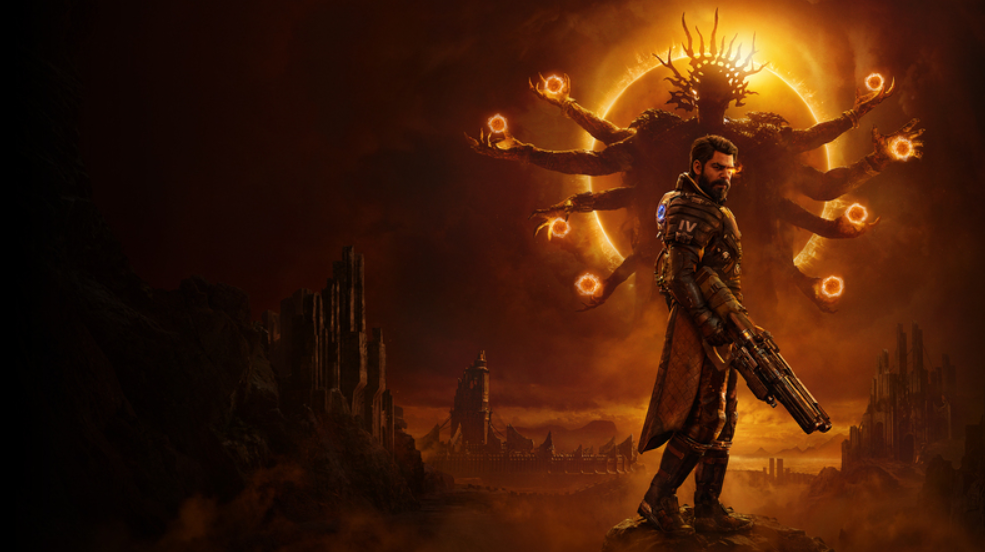
Set on the decaying off-world colony of Carcosa, Saros takes this desolate landscape and delivers a level of fidelity, lighting, and performance that serves as a supreme technical benchmark for the PlayStation 5 Pro.
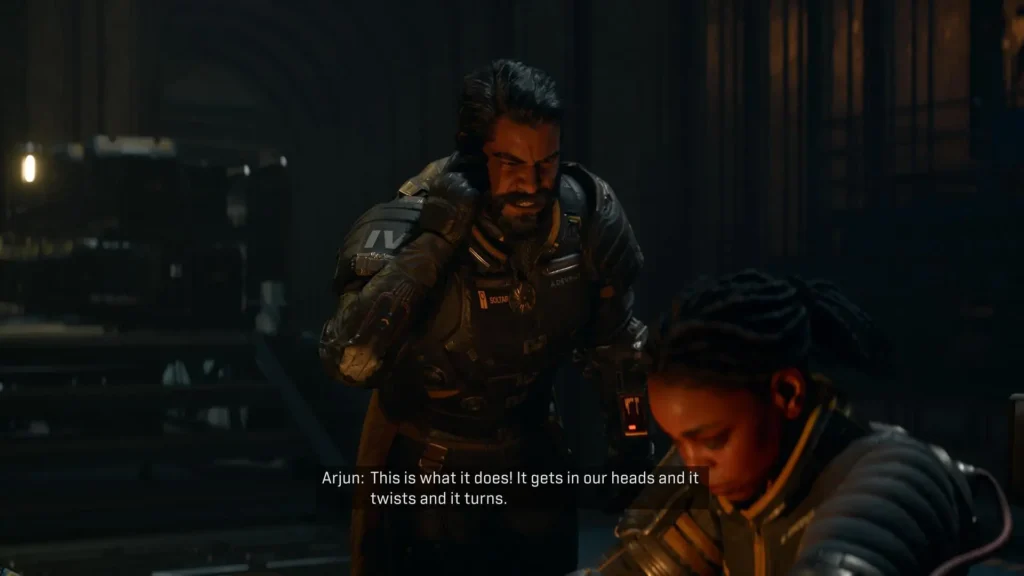
As Soltari Enforcer Arjun Devraj – brought to life with magnificent gravitas by actor Rahul Kohli – players are thrust into a world where the laws of physics are failing, and the echoes of a lost civilisation remain dangerously active.
The arrival on Carcosa serves as an immediate, uncompromising statement of intent – an ever-changing world presents a predatory landscape of shifting obsidian sands, brutalist ruins, and impossible geometric structures.
Housemarque has rigorously utilised the PlayStation 5 Pro’s expanded graphics processing capabilities to ensure that every single frame operates as a near-baroque work of art.
By fully implementing Sony’s snazzy PlayStation Spectral Super Resolution (PSSR) technology, the development team manages to maintain a razor-sharp 4K output while running at a buttery-smooth 60 frames per second – at least during gameplay.
This technical achievement is essential for a game that demands such extraordinary levels of player precision. The gorgeous reflections on shimmering metallic surfaces and the complex volumetric fog create a profound sense of physical presence. The environment pulls the player directly into Arjun’s desperate, claustrophobic struggle for survival, establishing a tone of dread that never relents.
Story
The narrative of Saros operates as a highly sophisticated exploration of grief, obsession, and the terrifying nature of the unknown. Arjun is a man fundamentally haunted by the disappearance of his wife, Nitya, during a disastrous research mission to the forbidden planet of Carcosa.
His journey functions as an act of personal penance. Through his investigation, he slowly uncovers the horrifying truth behind the ancient Soltari civilisation and the mysterious cosmic anomaly simply known as the Yellow Shore.
Housemarque draws heavily and explicitly from the weird fiction of Robert Chambers with multiple references, both subtle and overt. They have carefully constructed a setting that feels incredibly ancient and quietly malevolent. The storytelling relies heavily on quiet environmental observation – much like their PS5 predecessor Returnal – drip-feeding morsels of context and content and forcing the player to scrutinise the architecture and listen to scattered audio logs to piece together the tragic history of the doomed Echelon colonies.
As the narrative pushes forward, the boundary separating reality from hallucination begins to blur significantly. The Yellow Shore exists as an entity that grants god-like power at the severe cost of the user’s sanity, and its corrupting influence is deeply felt in every corner of the Carcosan landscape.
The writing remains exceptional throughout the campaign, actively avoiding typical action-movie clichés in favour of a much more contemplative, unsettling tone. The complex relationship between Arjun and the lingering memory of Nitya provides a vital, grounded human anchor to the high-concept science fiction.
This emotional core makes the final, reality-bending revelations feel genuinely earned and deeply moving, making for a story designed to linger in the mind long after the credits roll.
Gameplay
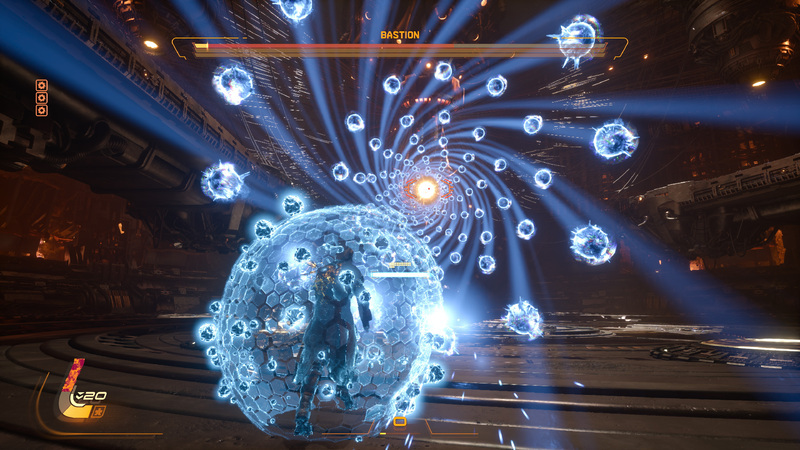
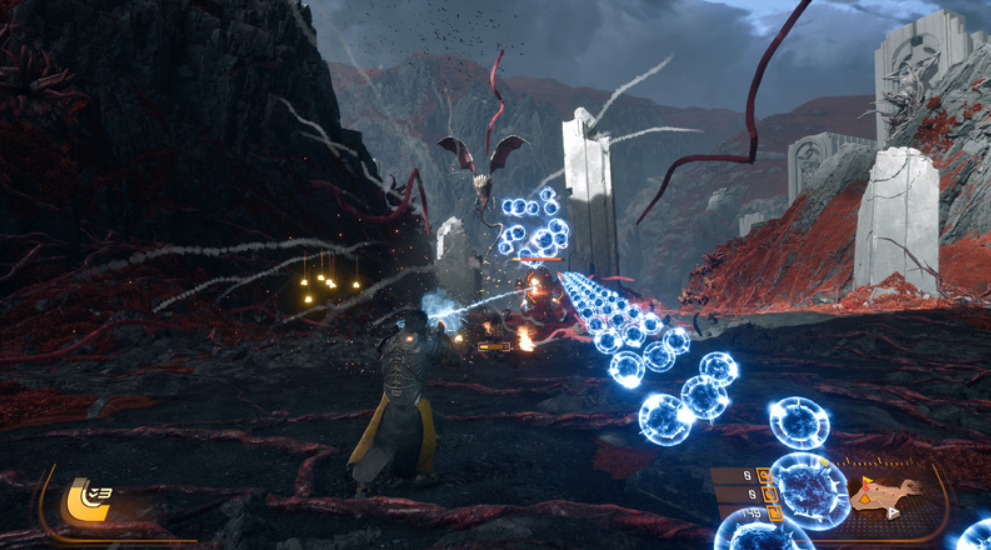
Combat in Saros represents a masterclass in risk/reward design philosophy. The core of the combat experience revolves around the Soltari Shield – a defensive tool that allows Arjun to absorb incoming projectile fire from hostile entities, but also acts as the primary engine of your offensive capabilities. Absorbing enemy energy allows you to charge Arjun’s heavily armoured arm, which can then be transformed into a wide variety of devastating Power Weapons.
This specific mechanic forces the player to play with extreme aggression, as players must frequently step directly into the path of overwhelming, screen-filling barrages to fuel their own destructive counter-attacks. It stands as a brilliant subversion of traditional cover-based shooting mechanics and forces constant engagement with enemies, richly rewarding players who can maintain their composure and situational awareness under extreme pressure.
The movement system feels equally refined. It offers a level of pinpoint responsiveness that fans expect from Housemarque’s best work. Arjun possesses a jet-assisted dash that grants a few crucial frames of invincibility. This manoeuvre allows him to weave safely through the dense, psychedelic patterns of glowing orbs that define the game’s spectacular boss encounters.
The action roguelite structure ensures that no two expeditions are identical. You continuously collect persistent resources to permanently upgrade your Soltari suit and unlock entirely new weapon archetypes at the Echelon IV base camp, creating a satisfying, steady sense of progression – and you’ll need it as the come-down after thirty-minute-long runs is brutal. Nevertheless, you pick your modifications and readily come back stronger for the next one.
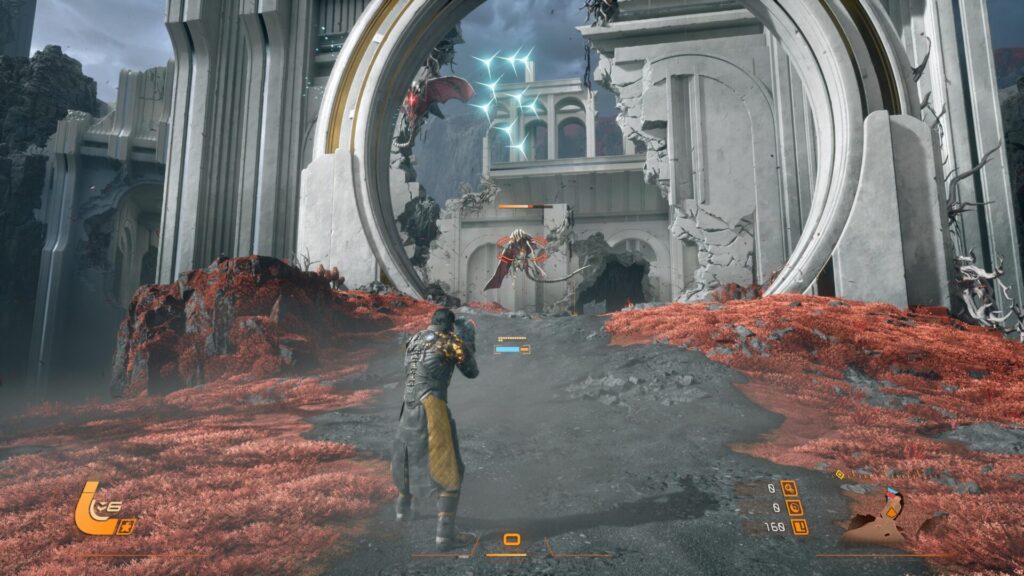
The enemy design remains varied and constantly terrifying. The roster features mechanical monstrosities and bioluminescent predators that dynamically adapt to your preferred tactics as you push deeper into the hostile zones.
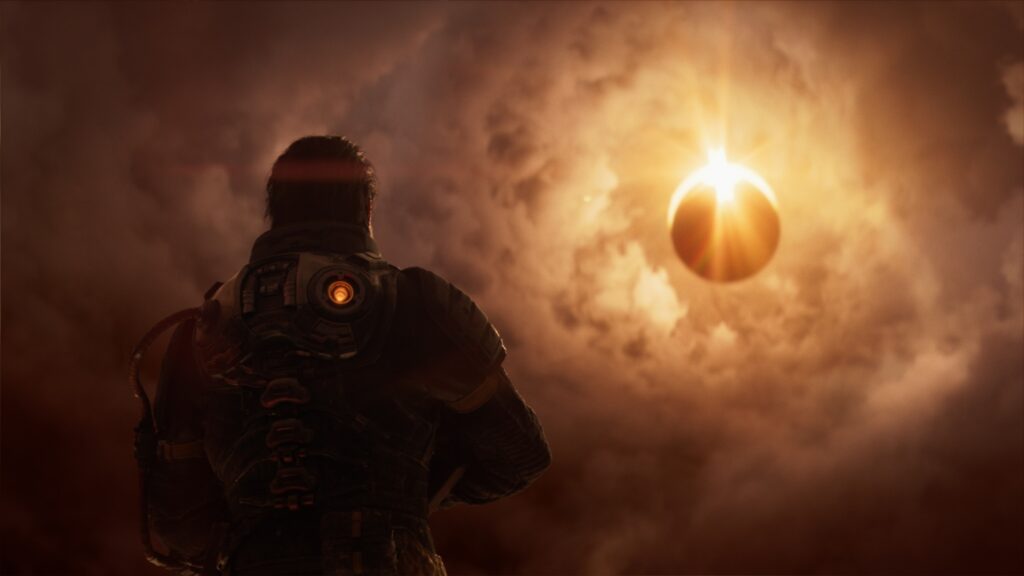
The ultimate test of your combat mastery arrives with the unpredictable Carcosan eclipses. These dynamic, mid-run events fundamentally alter the fabric of the active biome. As the alien sun is completely obscured, the landscape plunges into a twilight state bathed in a sickly yellow hue.
Enemy aggression scales instantly, and entirely new, temporally displaced horrors bleed into the environment. This sudden escalation forces an immediate tactical pivot. Players must quickly decide whether to sprint towards the safety of the nearest world-gate or stand their ground to harvest the ultra-rare temporal isotopes that only manifest during totality. The eclipse system guarantees that a comfortable run can transform into a desperate struggle for survival in seconds, keeping the tension remarkably high.
This escalation of the combat rounds out the symmetry of the risk/reward structure beautifully, as even the pick-ups during an eclipse have a duality of both improving some stats to the detriment of another. Do you opt for a boost to armour at the expense of strength, or boost your health, but lose additional lucenite – the ever-important currency for upgrades – upon taking damage?
The layers of complexity to the combat and level design are metered out much like the story, ultimately rewarding persistence and perseverance for those players up to the task.
Audio
The audio design in Saros ranks as the most sophisticated implementation on the PlayStation 5 to date. Housemarque has expertly utilised the Pro console’s dedicated processing power to deliver a 3D audio experience that feels genuinely transformative. The ambient soundscape provides a dense, oppressive layer of environmental noise, grinding mechanical crunchiness, and the distinctly unsettling whispers associated with the Yellow Shore.
In the absolute heat of battle, the spatial audio allows you to track multiple lethal threats across a vast three-dimensional space with surgical precision. You can distinctly hear the low hum of a charging laser building behind you, or the rapid skittering of an unseen predator hiding in the rafters. This audio clarity provides a massive, tangible tactical advantage during the most chaotic firefights.
The musical score delivers a stunning blend of traditional orchestral elements and heavy, industrial electronic synths, intelligently swelling and receding in direct response to the on-screen action. It successfully builds a sense of overwhelming operatic scale during the game’s massive, multi-phased boss encounters.
The voice acting is equally impressive throughout the campaign. Rahul Kohli’s performance as Arjun conveys a palpable sense of weary determination that fits the game’s oppressive tone perfectly, as do his ever-so slightly unsettling stranded crewmates.
Furthermore, every weapon discharge and shield absorption carries a specific, high-fidelity sound profile, translating directly into excellent haptic responses through the DualSense controller. Saros is nothing short of an audio tour-de-force.
Performance
On the PlayStation 5 Pro, Saros operates as a pure technical tour de force, delivering an image completely devoid of the distracting shimmering or ghosting artefacts that can sometimes plague lower-resolution titles during fast motion – and would have broken the immersion needed to keep up with this monster of a title.
The engine features dynamic shadows and accurate reflections that add a massive amount of visual depth to the brutalist environments, as the game flawlessly maintains its target 60 frames per second even when the screen is filled with complex particle effects and explosive fire-fights.
Load times are virtually non-existent due to the SSD integration. This specific technical advantage is a massive benefit for a game built around a repetitive loop structure. After suffering a death, you are back in the action at the base camp in mere moments…although each cycle is punctuated by lengthy discussions with crewmates that can grate if you’re overly eager to get back into the fray, but want to desperately learn more of the story.
The DualSense integration serves as another major highlight, as once again the pressure-sensitive nature of the adaptive triggers proves to be a key aspect of how you fight – a half-press unleashes your alt-fire, an unwieldy solution at first that quickly becomes second nature.
You can literally feel the distinct, subtle vibration of Carcosan rain hitting Arjun’s suit, and the intense, escalating buildup of energy in the controller before unleashing a massive Power Weapon. Every aspect of the Pro hardware has been utilised to make the player feel physically grounded within the world of Carcosa…although the impact is a little diminished versus the novelty of many of these features in Housemarque’s own Returnal (review here) back in 2020.
Verdict
Saros is a monumental achievement in modern game design. It successfully blends a high-concept, emotionally resonant narrative with best-in-class, arcade-inspired action mechanics. The final result is a premium experience that is both intellectually stimulating and physically demanding.
The exceptional technical polish present on the PlayStation 5 Pro remains unparalleled, making Saros an essential purchase for anyone who wants to witness the unleashed potential of Sony’s upgraded hardware.
Housemarque has successfully delivered a cosmic horror epic that will undoubtedly be remembered as one of the definitive games of the entire console generation. Saros is a haunting, surprisingly thoughtful, and relentlessly challenging journey that deeply rewards players – particularly those more patient – at every turn.


